Marina Mirage
TRSC three-stage marine investigation of Marina Mirage, Main Beach - chloride profiling, dive inspection, Make Safe and Monitor for the 1988 boardwalk.
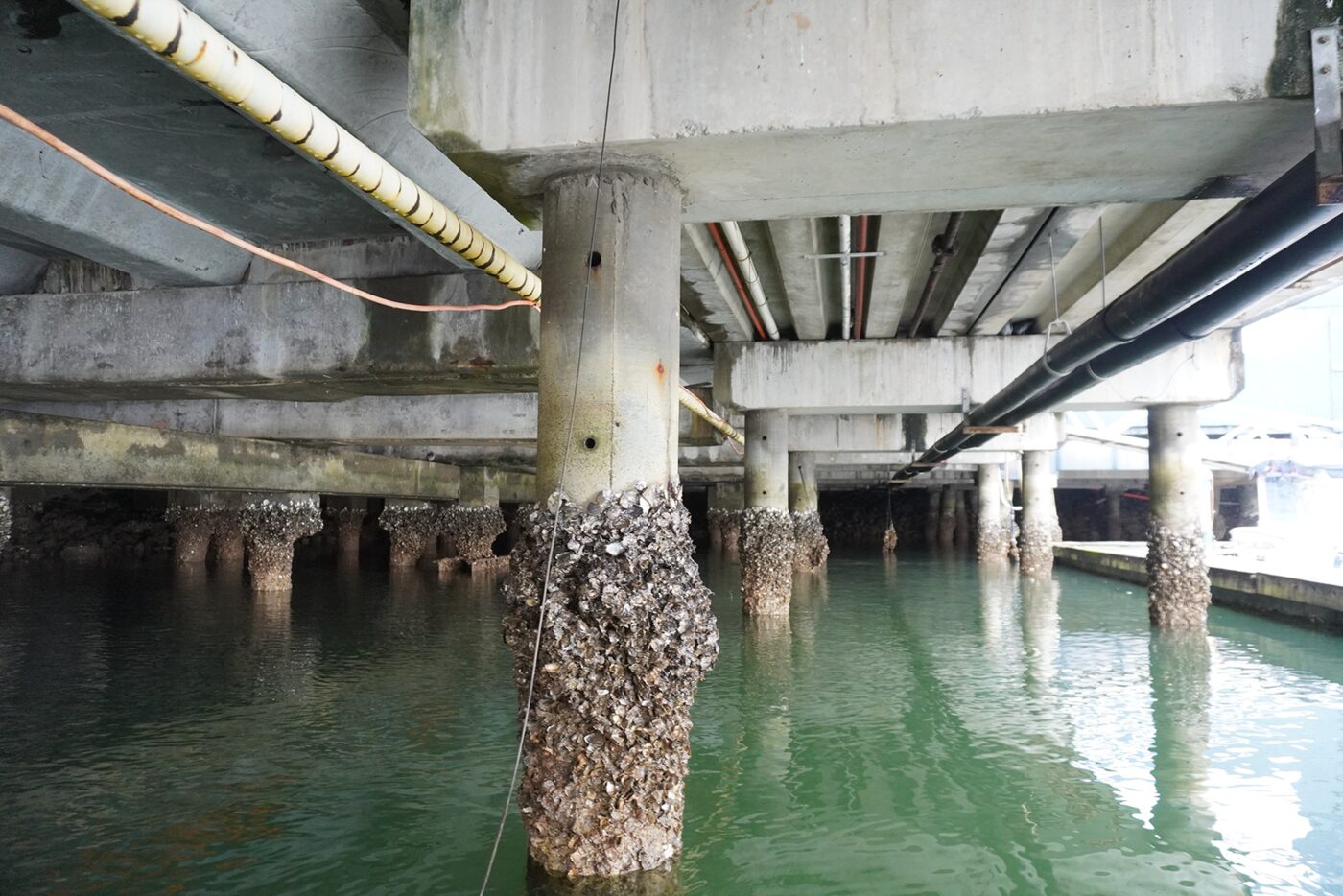
Marina Mirage is a waterfront retail, dining and marina precinct at 74 Seaworld Drive, Main Beach, on the Gold Coast Broadwater. The complex was constructed in 1987-1988 as part of the Mirage Resort masterplan developed by Christopher Skase's Qintex Group, and was designed by Desmond Brooks International with a deliberately Mediterranean aesthetic that referenced 1980s coastal hospitality architecture. The marine works comprise approximately 120 reinforced concrete piles supporting a system of pile caps, beams and precast deck planks across the boardwalk, plus a substantial boulder revetment wall protecting the landside edge of the complex from tidal action and small-vessel wake. The marina component supports vessel berthing for craft up to 70 metres LOA, with floating pontoons connected to fixed pile-supported gangways. Marina Mirage has changed hands several times since the 1989 Qintex collapse: it was acquired by Lend Lease Property in the 1990s, sold to private investors in the early 2000s, and is currently held by an institutional owner with Savills as asset manager. In 2024-2025 the precinct entered the early stages of a major redevelopment programme intended to refresh retail and dining tenancies, refurbish the marina edge, and restore boardwalk amenity. The structural challenge for Marina Mirage is exemplary of Gold Coast marine infrastructure of its era: 37-plus years of continuous saltwater immersion, splash-zone wet-dry cycling on the most-exposed elements, marine atmosphere chloride exposure on landside fabric, and an absence of complete original engineering documentation. The asset is approaching the end of its original design life but is not necessarily at end-of-life - a distinction that requires investigation rather than assumption to establish.
TRSC was engaged in 2025 by Inertia Engineering (acting on behalf of Savills) under OPUS programme 008 to deliver a three-stage marine structure investigation across the Marina Mirage boardwalk system in advance of a major redevelopment. Stage 1 was an initial condition assessment covering visual inspection and non-destructive testing of all accessible elements: reinforced concrete piles, pile caps, beams, precast deck planks, the boulder revetment wall, and the timber boardwalk decking. Stage 2 comprised a full destructive investigation including chloride profiling at multiple depths, carbonation testing, half-cell potential mapping for corrosion probability, residual service life modelling, and underwater dive inspection of all 120 marine piles coordinated with Harcan Marine Services. Stage 3 addressed the revetment wall investigation specifically. Investigation methodology spanned ground-penetrating radar, Ferroscan reinforcement location and cover surveys, Schmidt Hammer rebound testing, and structural capacity analysis evaluated against both current loading and the proposed redevelopment loads. Rather than recommending wholesale demolition (which had been the assumed default), TRSC applied a Make Safe and Monitor methodology that classified every structural element using a Green-Orange-Red retention/refurbishment/replacement matrix. Findings demonstrated that the majority of the 37-year-old infrastructure retained adequate structural capacity for continued service, and a make-safe and monitoring management plan was issued to ensure the structure remains serviceable throughout the multi-year redevelopment. RPEQ-signed reports cover all three stages.
Engineering questions about Marina Mirage
How old is Marina Mirage?
Did TRSC recommend demolishing the boardwalk?
How does TRSC inspect submerged marine piles?
What is the Green-Orange-Red classification system?
- Owner / OperatorMarina Mirage - official precinct site
- WikipediaMarina Mirage - Wikipedia
- GovernmentAS 3600-2018 Concrete Structures
- GovernmentAS 5100.5-2017 Bridge Design Concrete