Behind the Facade: What Heritage Building Walls Are Actually Hiding
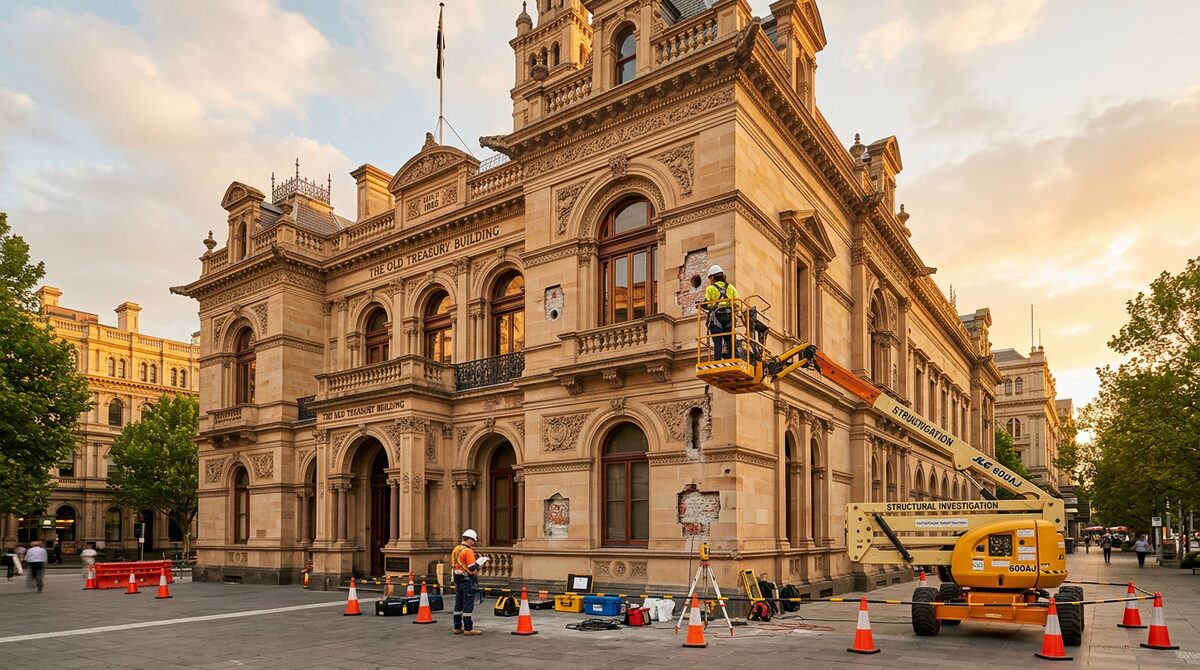
A 1890s Queenslander commercial building in inner Brisbane presented with a crack at a first-floor window - diagonal, approximately 300mm long, hairline at the top widening to two millimetres at the base. A remediation contractor had quoted $34,000 to repoint the affected section, attributing the cause to "settling." Before any work proceeded, an engineering investigation was commissioned.
What the investigation found reframed the problem entirely.
The Problem With What You Can See
Heritage buildings are deceptive. Their facades - sandstone, face brick, rendered masonry, cast iron - often appear exactly as they did a century ago. That visual continuity is part of their appeal. It's also part of the problem.
Behind those facades, a different story accumulates. Decades of undocumented modifications: walls opened and patched without records, steel lintels installed over new openings and left without corrosion protection, timber members spliced by tradespeople long gone, drainage rerouted through voids that were never designed to carry water. In buildings that predate the National Construction Code by fifty or a hundred years, there is often no documentation at all - no original drawings, no structural calculations, no material specifications.
When a crack appears, the visible evidence tells you something has changed. It does not tell you why, how far the change extends, or whether it is still progressing. Remediation without that information is guesswork, and in heritage buildings, guesswork is expensive in two directions: you either overspend on remediation that wasn't warranted, or you undertreat a defect that continues to develop behind a fresh joint.
The only way to close that gap is investigation.
What a Heritage Structural Investigation Actually Involves
The first thing we do on arrival is read the building - not just the crack, but the whole facade. Crack mapping is a discipline in itself. The pattern, orientation, width, taper, and location of cracking tells an experienced engineer a great deal about the underlying mechanism. Diagonal cracks propagating from window corners are typically consistent with differential settlement or load redistribution. Stepped cracks tracking through mortar joints suggest in-plane shear or differential movement. Horizontal cracks indicate lateral movement or moisture-driven expansion. Vertical cracks at wall junctions can point to differential thermal movement or failure of a wall tie.
At Thornton Arms, the crack pattern was broadly consistent with differential foundation movement - but consistent with is not the same as caused by. To establish the cause and extent of deterioration, we needed to see inside the wall. That requires non-destructive testing.
Ground-Penetrating Radar
GPR was the first instrument deployed. A ground-penetrating radar unit emits short-duration electromagnetic pulses into a surface and records the reflected signals as they return from material interfaces. In a masonry wall, this reveals voids, density changes, embedded metallic and non-metallic elements, and zones of elevated moisture content - all without opening the wall.
At Thornton Arms, GPR scanning of the affected panel identified a void behind the internal render, approximately 600mm wide and running vertically for around 1.2 metres, positioned directly above the cracked section. The void was consistent with an undocumented masonry removal - someone had cut out a section of the internal masonry leaf to run services, and the render had been patched over it. The wall had been carrying load across that void for an indeterminate period.
That single finding changed the entire scope. Repointing the external crack would have addressed the symptom. The structural void would have remained - continuing to progress.
Ferroscan
Ferroscan uses pulsed electromagnetic induction to detect and map metallic elements - primarily reinforcing steel - within concrete and masonry. In a 19th-century building, embedded reinforcement is not expected as a design element, but heritage structures are typically modified multiple times, and those modifications often introduced steel elements in locations that are now concealed.
At Thornton Arms, Ferroscan identified a steel lintel over a doorway inserted during what appeared to be a 1960s renovation. The lintel was carrying load, but its bearing length on the support side was less than 100mm - a marginal condition by any assessment standard. More critically, active corrosion was confirmed in the lintel body, with corrosion staining visible in the adjacent mortar zone. Without Ferroscan, that lintel would have been invisible behind the render. With it, we had a defined structural element with an identified failure mechanism.
Ultrasonic Pulse Velocity
UPV testing measures the transmission velocity of an ultrasonic pulse through a material. In sound, homogeneous masonry, the pulse travels rapidly. In masonry that is cracked, voided, or chemically degraded, velocity drops. By conducting readings across a systematic grid on the wall surface, you can map material quality and identify zones of internal weakness that present no visible surface symptoms.
This is particularly significant in heritage masonry. Nineteenth-century lime mortars behave very differently from modern Portland cement mortars. They are softer, more flexible, more vapour-permeable, and more vulnerable to particular degradation pathways - including moisture-driven dissolution of the calcium carbonate binder. UPV testing at Thornton Arms identified a zone of significantly reduced pulse velocity in the lower wall, consistent with moisture-degraded lime mortar. The affected zone extended approximately three times further than the visible cracking alone would have indicated.
Schmidt Hammer
The Schmidt Hammer is a rebound hardness test - a spring-loaded plunger strikes the surface and the rebound energy is measured as a proxy for surface hardness and relative compressive strength. It is a rapid, non-invasive method for comparing zones within the same wall and identifying areas of localised material degradation.
At Thornton Arms, Schmidt Hammer readings corroborated the UPV data: the lower wall section showed consistently lower rebound values, confirming reduced mortar strength in precisely the zone identified by pulse velocity testing.
Borescope Investigation
Where the NDT data indicated specific internal features warranting direct visual confirmation, a borescope was used to inspect selected mortar joints and access points without structural disturbance. Borescope investigation provided direct visual assessment of the void geometry and the lintel bearing condition - confirming what the GPR and Ferroscan data had indicated and removing ambiguity from the remediation scope before a single brick was removed.
What the Investigation Found
By the end of the investigation programme, the picture was substantially different from "settling." The full findings included:
- A 600mm void behind internal render, directly above the cracked zone, consistent with an undocumented masonry removal to run services - not present in any building records
- A steel lintel from a 1960s renovation with less than 100mm bearing and active corrosion confirmed in the lintel body and adjacent mortar
- Moisture-degraded lime mortar in the lower wall section, extending approximately three times further than the visible cracking would have suggested
- Evidence of a previous cement repointing campaign - the harder, more rigid cement mortar concentrating stress at the interface with the original lime fabric, contributing directly to the cracking pattern
None of this was visible from the surface. None of it would have been addressed by the $34,000 repointing quote.
The Extent and Severity Question
One of the most important functions of a structural investigation is answering two questions that visual inspection cannot: how far does this problem extend, and how severe is it?
Those two questions determine everything that follows. A defect that is localised and stable demands a very different response from one that is widespread and progressing. Without NDT data, a remediation contractor pricing a heritage wall has no choice but to assume worst-case extent - because they don't know otherwise, and they cannot afford to be wrong. That uncertainty is priced into the quote.
At Thornton Arms, the investigation data allowed the affected zones to be defined precisely. The moisture-degraded mortar was confined to a discrete section of the lower wall. The void was bounded and fully mapped. The lintel issue was localised to a single opening. Remediation could therefore be targeted - addressing the actual defect zones rather than the entire wall face.
With the extent and severity determined, a refined remediation scope was issued. The final cost: $16,000. A blanket facade repoint - which is what gets proposed when the extent is unknown - would have cost significantly more and left the void, the lintel, and the mortar degradation active behind a fresh joint.
Heritage Fabric and the Obligation to Understand Before You Act
There is a further dimension to heritage investigation that goes beyond cost. Heritage fabric - the original materials, construction techniques, and spatial arrangements of a significant building - carries value that is not purely financial. Once removed, it cannot be replaced. The lime mortar in a 19th-century masonry wall is not merely a structural material. It is a physical record of how the building was made, and of how it has behaved across more than a century of use.
This is why the approach to heritage investigation must be different from standard commercial assessment. The principle is: understand before you touch. NDT methods are well-suited to this discipline because they gather information without altering the fabric being investigated. Where physical investigation is required - mortar sampling for petrographic analysis, targeted core drilling to establish wall construction - it should be minimal, targeted, and fully documented. Every intervention in a heritage building should be justified by a specific question that cannot be answered any other way.
This philosophy underpins the way TRSC approaches heritage work. The first step, where there is an immediate risk, is to make the building safe. The second is to gather evidence. Remediation follows from evidence - not from assumption, and not from a contractor's estimate of worst-case scope. You can read more about this approach in the [Prince Consort Hotel](/preview/trsc/projects/prince-consort) and [Victory Hotel](/preview/trsc/projects/victory-hotel) case studies, where similar investigative methods revealed conditions that would have been missed entirely by visual inspection alone.
What Owners and Asset Managers Should Know
Heritage buildings don't fail where you can see them. They fail behind render, inside cavities, at the interfaces between original fabric and undocumented modifications.
If you manage or own a heritage building, a few points are worth keeping in mind:
Visible cracking is a signal, not a diagnosis. The crack tells you something has changed. It does not tell you what, why, or how far the change extends. Commissioning a remediation quote before you have an investigation is addressing the symptom while the cause remains active.
Undocumented modifications are the norm, not the exception. Buildings that are fifty, a hundred, or a hundred and fifty years old have almost always been modified - often repeatedly, often without records. Those modifications can introduce structural vulnerabilities that are entirely invisible from the surface.
NDT methods can answer most questions without touching the fabric. GPR, Ferroscan, UPV, Schmidt Hammer, and borescope investigation can collectively map conditions inside walls, floors, and columns without drilling, cutting, or removing material. In most cases, they provide sufficient data to scope remediation accurately and defensibly.
The investigation cost is not an additional expense - it's a reduction in remediation risk. When the extent and severity of a problem are known, remediation can be priced accurately and targeted precisely. When they're not, contractors price the unknown - and you pay for it either through an inflated scope or an undertreated defect.
Form 12 and Form 15 certification requirements in Queensland mean the engineering has to be done properly. There is no shortcut through the compliance process for building work on heritage structures. Getting the investigation right from the start avoids the delays and cost of revisiting inadequate documentation later.
After Thornton Arms
The owner's building received the targeted remediation it required. The void was filled with a compatible grout specified to match the density and stiffness of the surrounding masonry. The lintel was properly restrained and treated for corrosion. The moisture-affected mortar was replaced with a lime-based mix compatible with the original fabric - not cement, which would have concentrated stress and replicated the problem in a different location. The external cracking was repointed last, once the underlying causes had been resolved.
The investigation produced something beyond a rectified building: a documented baseline of the structure's actual condition - NDT data, condition maps, and a defined framework for monitoring the elements that warranted ongoing attention.
Investigation before remediation. Every time.
If you're managing a heritage or older building and have questions about structural condition, undocumented modifications, or how to approach a defect that's appeared, TRSC's team works across Queensland, New South Wales, and Victoria. More information is available at [trsc.au](https://trsc.au).